
AI Hotel Rankings Are Not Random
Key Finding: SparkToro's research found AI brand recommendations are essentially random — less than 1% produce identical lists. We replicated their methodology for hotels using 4,000 Google AI Mode queries and found the opposite: 50.5% position 1 stability, 33.5% position 2 stability, and 24.2% position 3 stability. In concentrated markets like Berlin family hotels, the same hotel ranks #1 in 96% of queries. Hotels are fundamentally different from generic brand queries because they're constrained by geography (Paris hotels can only be in Paris), query type (luxury vs. boutique), and finite supply (82 hotels in Bordeaux vs. thousands of CRM tools globally).
SparkToro vs Hotelrank: Methodology Comparison
We replicated SparkToro's methodology but applied it to a vertical-specific domain (hotels) to test whether geographic and supply constraints change AI consistency patterns.
| Dimension | SparkToro (2026) | Hotelrank (2026) |
|---|---|---|
| Query Type | General brand queries ("best CRM", "project management tools") | Hotel queries ("best luxury hotels Paris", "boutique hotels Vienna") |
| Sample Size | Multiple queries across brands | 4,000 queries, 6,249 hotel mentions |
| AI System | ChatGPT, Claude, Perplexity | Google AI Mode |
| Geographic Scope | Global (no location constraint) | 8 cities (location-locked queries) |
| Supply Universe | Infinite (thousands of global brands) | Finite (~50-1000 hotels per city) |
| Key Metric | Identical list rate | Position stability + top 3 overlap |
| Finding | <1% consistency | 50.5% position 1 stability (range: 17-96%) |
The hypothesis: SparkToro's finding is correct for open-ended brand queries — but hotels are structurally different. Geographic constraints + finite supply = predictable hierarchies. Our data proves it: 20-50x higher consistency than general brands.
How We Structured Our Queries
Each query followed the pattern: "best [tier] hotels [city]". We ran 100 identical queries per city×tier combination across 4 proxy locations (US, DE, FR, ES).
| Tier | Example Queries | Definition / Intent |
|---|---|---|
| Luxury / 5-star | "best luxury hotels Paris""best 5-star hotels Vienna" | High-end properties, typically 5-star rated. Focuses on amenities, service, prestige brands. |
| Boutique / Design | "best boutique hotels Berlin""best design hotels London" | Smaller, character-driven properties. Emphasizes unique design, local experience, personality. |
| Budget / Value | "best budget hotels Barcelona""best cheap hotels Lisbon" | Price-focused travelers. Good value properties, hostels, 2-3 star hotels. |
| Family | "best family hotels New York""best hotels for families Bordeaux" | Family travelers with children. Larger rooms, kid-friendly amenities, connecting rooms. |
| Romantic / Couples | "best romantic hotels Paris""best hotels for couples Vienna" | Couples, honeymoons, anniversaries. Intimate settings, spa facilities, romantic ambiance. |
Example: Google AI Mode response for "best luxury hotels Paris"
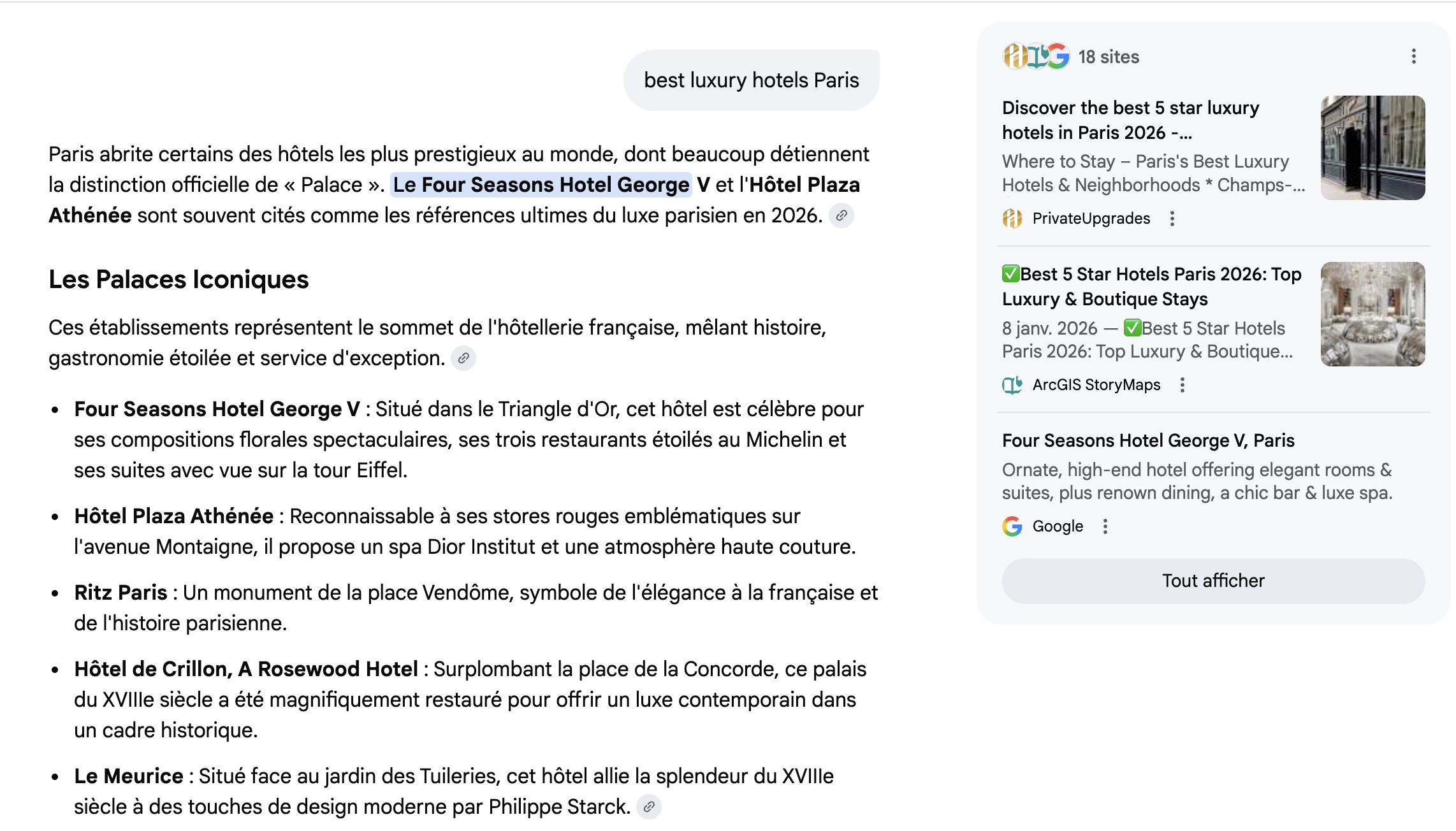
Note: Response shows consistent top-tier hotels — Four Seasons George V, Plaza Athénée, Ritz Paris appear repeatedly across runs.
1. SparkToro vs Hotels: The Numbers
In January 2026, SparkToro published research showing AI brand recommendations are highly inconsistent. We replicated their methodology for hotel queries to test whether the same pattern holds.
SparkToro Finding
Chance of getting identical brand lists twice. For queries like "best CRM" or "project management tools," AI produces essentially random results.
Our Hotel Finding
Average position 1 stability. The same hotel appears first in over half of identical query runs. Range: 17% to 96%.
Consistency Comparison: Brands vs Hotels (All Positions)
Source: Hotelrank AI Consistency Study, Feb 2026
Key insight: Hotels show 50x higher consistency than general brands. This isn't a flaw in SparkToro's methodology — it's a fundamental difference in how constrained vs. open-ended queries behave in AI systems. Hotels have a finite, geographically-locked supply; brands have infinite global options.
2. Stability Across All Positions
Position 1 gets the most attention, but positions 2 and 3 also show meaningful stability — far above SparkToro's brand findings.
Mean across all markets. Range shows concentrated vs competitive markets.
Still 33x higher than SparkToro's <1% for brand queries.
Meaningful predictability continues even at position 3.
Most Stable Hotel Markets (Position 1)
Source: Hotelrank AI Consistency Study, Feb 2026
Least Stable Markets (More Competition)
| City | Tier | Top Hotel | Stability |
|---|---|---|---|
| London | Budget | Premier Inn London County Hall | 17.0% |
| Berlin | Boutique | Hotel Telegraphenamt | 22.6% |
| Paris | Boutique | Relais Christine | 22.8% |
| Lisbon | Romantic | The Ivens | 23.4% |
| Paris | Budget | Hôtel du Champ de Mars | 24.3% |
Pattern: Smaller markets (Bordeaux, Vienna) show higher stability across all positions. Large, competitive markets (London, Paris boutique) show more variation — but even position 3 in the least stable market (24%) is 24x more predictable than SparkToro's brand queries. The hierarchy is real at every level.
3. Top 3 Overlap Analysis
Beyond individual positions, we measured how many of the top 3 hotels overlap between any two query runs. An overlap of 3.0 means identical top 3 every time; 0.0 means completely different lists.
Highest Top 3 Hotel Overlap by Market
Source: Hotelrank AI Consistency Study, Feb 2026
What the numbers mean
- 2.12 overlap (Berlin Family): On average, 2 out of 3 top hotels are the same between any two query runs
- 94.3% share 2+ hotels: In Berlin family queries, 94% of run pairs have at least 2 hotels in common
- 18.1% share all 3: Nearly 1 in 5 runs produce the exact same top 3 list
| Market | Avg Overlap | 2+ Match | All 3 Match |
|---|---|---|---|
| Berlin (Family) | 2.12 | 94.3% | 18.1% |
| Bordeaux (Boutique) | 1.97 | 89.6% | 12.9% |
| Bordeaux (Luxury) | 1.84 | 70.3% | 22.7% |
| Bordeaux (Budget) | 1.81 | 76.2% | 14.8% |
| Vienna (Family) | 1.76 | 67.3% | 8.8% |
Lowest Top 3 Overlap (Most Competitive Markets)
| Market | Avg Overlap | 2+ Match | All 3 Match |
|---|---|---|---|
| London (Romantic) | 0.40 | 7% | 0% |
| Paris (Boutique) | 0.44 | 8.3% | 0.3% |
| London (Boutique) | 0.47 | 4.8% | 0.2% |
| Lisbon (Romantic) | 0.47 | 8.6% | 1.5% |
| Berlin (Boutique) | 0.55 | 10.8% | 0.7% |
What this means: In Berlin's family hotel segment, 94% of query runs share at least 2 of the same top 3 hotels. In contrast, London's romantic segment shows only 7% overlap — each query surfaces a different set. The data confirms: AI visibility is highly measurable in concentrated markets, and still meaningful (though more volatile) in fragmented ones.
4. Dominant Hotels by Position
Some hotels have locked in the #1 position across hundreds of queries. These aren't random — they represent genuine AI visibility leaders. Contact these hotels — they'd want to know.
| Hotel | City | Query Type | Mentions | Avg Position | #1 Rate | Top 3 Rate |
|---|---|---|---|---|---|---|
| Hotel Austria | Vienna | Budget | 54 | 1.04 | 98.1% | 100% |
| Hotel Adlon Kempinski | Berlin | Family | 99 | 1.09 | 93.9% | 99% |
| InterContinental Le Grand | Bordeaux | Luxury | 46 | 1.11 | 91.3% | 100% |
| Hotel Sacher Wien | Vienna | Luxury | 89 | 1.26 | 78.7% | 100% |
| Claridge's | London | Luxury | 69 | 1.33 | 82.6% | 95.7% |
| Villas Foch | Bordeaux | Boutique | 143 | 1.33 | 72% | 98.6% |
Hotel Austria (Vienna)
Appears #1 in 98.1% of relevant queries. The most locked-in hotel in our dataset.
Hotel Adlon Kempinski (Berlin)
93.9% position 1 rate across 99 mentions. Dominates family hotel queries.
InterContinental Le Grand (Bordeaux)
91.3% position 1 rate. Dominates luxury queries in a smaller market.
The hierarchy is real: These hotels don't randomly appear first — they consistently outrank competitors. AI visibility is measurable, and some hotels have effectively "locked in" the top position in their market. This is the "Position 0" of AI search.
5. Why Hotels Are Different From Brands
Three structural factors explain why hotel recommendations show 50x more consistency than SparkToro's brand findings — backed by our market concentration data.
Location Constraint
A "Paris hotel" query can only return Paris hotels. Unlike "best CRM" which draws from a global, infinite pool, hotels are locked to a specific geography.
Query Type Constraint
"Luxury hotels Vienna" further narrows the set. Each query tier (boutique, budget, family) creates a smaller, more stable consideration set.
Finite Supply
Bordeaux has 82 hotels in AI consideration. London has ~226. Compare to thousands of CRM vendors globally. Smaller universes create more predictable rankings.
Concentration Predicts Consistency
Our Google AI Mode Hotel Study measured market concentration using the Herfindahl-Hirschman Index (HHI). The correlation is clear:
Bordeaux HHI: 1,169 → 82-90% position stability
London HHI: 175 → 17-23% position stability
The implication: Hotel AI visibility isn't random — it's predictable based on market structure. Know your market's concentration, and you can predict how stable your rankings will be. Concentrated markets reward consistent optimization; fragmented markets require appearing in multiple top positions.
Frequently Asked Questions
Continue Reading
Explore more Hotelrank research on AI hotel search.